 Add to Chrome
 Add to Firefox
 Add to Edge
AliMark: Enhancing Robustness of Sentence-Level Watermarking Against Text Paraphrasing
May 28, 2026
Existing sentence-level watermarking methods enhance robustness to paraphrasing by anchoring watermarks in sentence semantics. However, their prefix-based designs remain vulnerable to structural perturbations, such as sentence splitting and merging, which commonly arise under strong paraphrasers like DIPPER and GPT-3.5. To mitigate this issue, we propose AliMark, a framework that reformulates sentence-level watermarking as a bit sequence encoding and alignment problem between a potentially watermarked text and a secret bit sequence. Notably, our approach adopts a two-stage detection strategy: we generate multiple restructured text variants and adaptively align their extracted bit sequences with the secret bit sequence to minimize alignment cost. This multi-candidate alignment design naturally improves robustness to sentence merges and splits. Extensive experiments demonstrate that AliMark substantially outperforms state-of-the-art baselines under diverse paraphrasing attacks.

Echoes within the Reasoning: Stealthy and Effective Watermarking via Chain of Thought
May 27, 2026Large Language Models with Chain-of-Thought reasoning capabilities represent valuable intellectual property, yet existing black-box watermarking methods often trade robustness for reasoning fidelity by perturbing final answers or relying on fragile trigger patterns. We propose BiCoT, a watermarking framework that embeds ownership signals into the internal geometry of reasoning traces by aligning high-saliency structural anchors with a private signature subspace while regularizing ordinary control tokens to preserve semantic capacity. This design couples the watermark with reasoning-relevant representations, making removal difficult without disrupting the features that support coherent reasoning. To enable verification under model theft and representation drift, we introduce Robust Subspace Registration (RSR), a Top- logprob-based black-box verifier that uses sentinel tokens to calibrate systematic shifts in the output distribution. Experiments show that BiCoT preserves reasoning fidelity across diverse complex reasoning tasks while achieving robust detection under fine-tuning, quantization, model-level perturbations, and adaptive output-level attacks across in-domain and out-of-distribution settings.
SAMark: A Self-Anchored Text Watermarking with Paragraph-Level Paraphrase Robustness
May 25, 2026Semantic-level watermarking (SWM) improves robustness against text modifications by treating sentences as the basic unit. However, robustness to paragraph-level paraphrasing remains difficult because such attacks globally disrupt watermark signals by changing sentence order. In this work, we propose SAMark, a self-anchored watermarking framework that removes the dependency on sentence order by establishing a step-independent green region in semantic space. To improve detectability, we introduce a multi-channel hyperbolic scoring mechanism that amplifies watermark signals while suppressing noise from weakly aligned candidates. We further propose a diversity-aware filtering strategy that combines hard filtering with soft regularization, extending beyond simple n-gram repetition filters to address semantic redundancy. Experimental results show that SAMark achieves up to 90.2% TP@FP1% under typical paragraph-level paraphrasing attacks, outperforming the strongest prior baseline by more than 30% on average, while maintaining generation quality competitive with unwatermarked text and breaking the robustness-quality trade-off that limits prior methods.
IMMACULATE: A Practical LLM Auditing Framework via Verifiable Computation
Feb 26, 2026Commercial large language models are typically deployed as black-box API services, requiring users to trust providers to execute inference correctly and report token usage honestly. We present IMMACULATE, a practical auditing framework that detects economically motivated deviations-such as model substitution, quantization abuse, and token overbilling-without trusted hardware or access to model internals. IMMACULATE selectively audits a small fraction of requests using verifiable computation, achieving strong detection guarantees while amortizing cryptographic overhead. Experiments on dense and MoE models show that IMMACULATE reliably distinguishes benign and malicious executions with under 1% throughput overhead. Our code is published at https://github.com/guo-yanpei/Immaculate.
On Representation Redundancy in Large-Scale Instruction Tuning Data Selection
Feb 14, 2026Data quality is a crucial factor in large language models training. While prior work has shown that models trained on smaller, high-quality datasets can outperform those trained on much larger but noisy or low-quality corpora, systematic methods for industrial-scale data selection in instruction tuning remain underexplored. In this work, we study instruction-tuning data selection through the lens of semantic representation similarity and identify a key limitation of state-of-the-art LLM encoders: they produce highly redundant semantic embeddings. To mitigate this redundancy, we propose Compressed Representation Data Selection (CRDS), a novel framework with two variants. CRDS-R applies Rademacher random projection followed by concatenation of transformer hidden-layer representations, while CRDS-W employs whitening-based dimensionality reduction to improve representational quality. Experimental results demonstrate that both variants substantially enhance data quality and consistently outperform state-of-the-art representation-based selection methods. Notably, CRDS-W achieves strong performance using only 3.5% of the data, surpassing the full-data baseline by an average of 0.71% across four datasets. Our code is available at https://github.com/tdano1/CRDS.
Reliable and Responsible Foundation Models: A Comprehensive Survey
Feb 04, 2026Foundation models, including Large Language Models (LLMs), Multimodal Large Language Models (MLLMs), Image Generative Models (i.e, Text-to-Image Models and Image-Editing Models), and Video Generative Models, have become essential tools with broad applications across various domains such as law, medicine, education, finance, science, and beyond. As these models see increasing real-world deployment, ensuring their reliability and responsibility has become critical for academia, industry, and government. This survey addresses the reliable and responsible development of foundation models. We explore critical issues, including bias and fairness, security and privacy, uncertainty, explainability, and distribution shift. Our research also covers model limitations, such as hallucinations, as well as methods like alignment and Artificial Intelligence-Generated Content (AIGC) detection. For each area, we review the current state of the field and outline concrete future research directions. Additionally, we discuss the intersections between these areas, highlighting their connections and shared challenges. We hope our survey fosters the development of foundation models that are not only powerful but also ethical, trustworthy, reliable, and socially responsible.
Efficient Reasoning via Chain of Unconscious Thought
May 26, 2025Large Reasoning Models (LRMs) achieve promising performance but compromise token efficiency due to verbose reasoning processes. Unconscious Thought Theory (UTT) posits that complex problems can be solved more efficiently through internalized cognitive processes. Inspired by UTT, we propose a new reasoning paradigm, termed Chain of Unconscious Thought (CoUT), to improve the token efficiency of LRMs by guiding them to mimic human unconscious thought and internalize reasoning processes. Concretely, we first prompt the model to internalize the reasoning by thinking in the hidden layer. Then, we design a bag of token-efficient strategies to further help models reduce unnecessary tokens yet preserve the performance. Our work reveals that models may possess beneficial unconscious thought, enabling improved efficiency without sacrificing performance. Extensive experiments demonstrate the effectiveness of CoUT. Remarkably, it surpasses CoT by reducing token usage by 47.62% while maintaining comparable accuracy, as shown in Figure 1. The code of CoUT is available at this link: https://github.com/Rohan-GRH/CoUT
Silent Leaks: Implicit Knowledge Extraction Attack on RAG Systems through Benign Queries
May 21, 2025Retrieval-Augmented Generation (RAG) systems enhance large language models (LLMs) by incorporating external knowledge bases, but they are vulnerable to privacy risks from data extraction attacks. Existing extraction methods typically rely on malicious inputs such as prompt injection or jailbreaking, making them easily detectable via input- or output-level detection. In this paper, we introduce Implicit Knowledge Extraction Attack (IKEA), which conducts knowledge extraction on RAG systems through benign queries. IKEA first leverages anchor concepts to generate queries with the natural appearance, and then designs two mechanisms to lead to anchor concept thoroughly 'explore' the RAG's privacy knowledge: (1) Experience Reflection Sampling, which samples anchor concepts based on past query-response patterns to ensure the queries' relevance to RAG documents; (2) Trust Region Directed Mutation, which iteratively mutates anchor concepts under similarity constraints to further exploit the embedding space. Extensive experiments demonstrate IKEA's effectiveness under various defenses, surpassing baselines by over 80% in extraction efficiency and 90% in attack success rate. Moreover, the substitute RAG system built from IKEA's extractions consistently outperforms those based on baseline methods across multiple evaluation tasks, underscoring the significant privacy risk in RAG systems.
Sparse Autoencoder as a Zero-Shot Classifier for Concept Erasing in Text-to-Image Diffusion Models
Mar 12, 2025Text-to-image (T2I) diffusion models have achieved remarkable progress in generating high-quality images but also raise people's concerns about generating harmful or misleading content. While extensive approaches have been proposed to erase unwanted concepts without requiring retraining from scratch, they inadvertently degrade performance on normal generation tasks. In this work, we propose Interpret then Deactivate (ItD), a novel framework to enable precise concept removal in T2I diffusion models while preserving overall performance. ItD first employs a sparse autoencoder (SAE) to interpret each concept as a combination of multiple features. By permanently deactivating the specific features associated with target concepts, we repurpose SAE as a zero-shot classifier that identifies whether the input prompt includes target concepts, allowing selective concept erasure in diffusion models. Moreover, we demonstrate that ItD can be easily extended to erase multiple concepts without requiring further training. Comprehensive experiments across celebrity identities, artistic styles, and explicit content demonstrate ItD's effectiveness in eliminating targeted concepts without interfering with normal concept generation. Additionally, ItD is also robust against adversarial prompts designed to circumvent content filters. Code is available at: https://github.com/NANSirun/Interpret-then-deactivate.
Lazarus: Resilient and Elastic Training of Mixture-of-Experts Models with Adaptive Expert Placement
Jul 05, 2024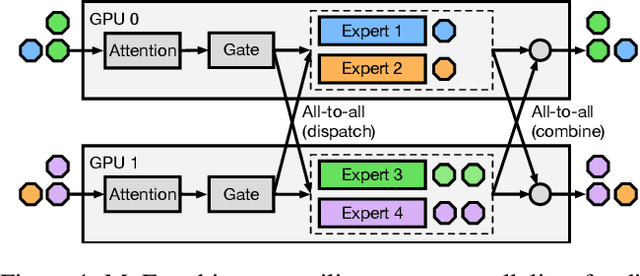

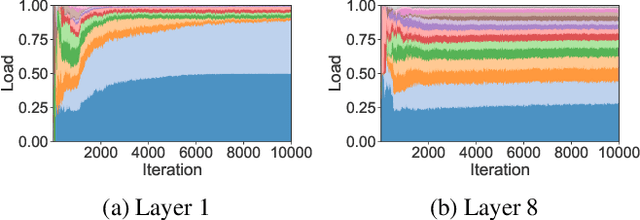

Sparsely-activated Mixture-of-Experts (MoE) architecture has increasingly been adopted to further scale large language models (LLMs) due to its sub-linear scaling for computation costs. However, frequent failures still pose significant challenges as training scales. The cost of even a single failure is significant, as all GPUs need to wait idle until the failure is resolved, potentially losing considerable training progress as training has to restart from checkpoints. Existing solutions for efficient fault-tolerant training either lack elasticity or rely on building resiliency into pipeline parallelism, which cannot be applied to MoE models due to the expert parallelism strategy adopted by the MoE architecture. We present Lazarus, a system for resilient and elastic training of MoE models. Lazarus adaptively allocates expert replicas to address the inherent imbalance in expert workload and speeds-up training, while a provably optimal expert placement algorithm is developed to maximize the probability of recovery upon failures. Through adaptive expert placement and a flexible token dispatcher, Lazarus can also fully utilize all available nodes after failures, leaving no GPU idle. Our evaluation shows that Lazarus outperforms existing MoE training systems by up to 5.7x under frequent node failures and 3.4x on a real spot instance trace.